Para Karate Kata Competition Rules (2026)
ARTICLE 1: PARA KARATE KATA COMPETITION
1.1 Para Karate is the modality of Karate adapted for Athletes with disabilities. The Para Karate Kata Competition Rules and Regulations have been formulated to preserve Athlete safety, as well as to promote fair competition by means of a transparent and consistent set of standards. These rules are applicable to and must be followed by all Athletes, Coaches, Classification Personnel, Judges, and other Support Personnel who organise and/or participate in any WKF-recognised Para Karate Competition.
1.2 The following Rules and Regulations are mandatory for all WKF Para Karate events, as well as for other WKF-recognised competitions. Any competition that does not follow the standards of these sets of Rules cannot be recognised as a WKF Para Karate Competition.
ARTICLE 2: DISCIPLINE, CATEGORIES AND SPORT CLASSES
2.1. Discipline and Categories
2.1.1. Para Karate competitions include Individual Kata only. Athletes compete in one of the following categories, aligned with the Eligible Impairment types recognised by the IPC:
- a. Visual Impairment – Sport Class K10
- b. Intellectual Impairment – Sport Classes K21 and K22
- c. Physical Impairment – Sport Class K30
2.1.2. Each category is divided into Sport Classes, as defined within the WKF Para Karate Classification Rules, which describe how Athletes are allocated to classes based on the degree to which their Eligible Impairment impacts performance of the specific activities required in Kata.
2.1.3. Athletes with more than one Eligible Impairment may compete in only one Sport Class per championship. Allocation of the Sport Class is determined according to the processes described in the WKF Para Karate Classification Rules.
2.1.4. In Sport Classes K10 and K30, a Compensation Score is allocated to Athletes in accordance with the WKF Para Karate Classification Rules. This score reflects the extent to which the Athlete's impairment impacts performance and is added to the Judges' Score as described in the Scoring section of these rules.
For detailed procedures and eligibility criteria, please refer to the WKF Para Karate Classification Rules.
2.2. Para Karate Sport Classes
Sport Classes are competition subcategories that group Athletes with similar activity limitations resulting from their Eligible Impairment, to ensure fair and meaningful competition. Sport Classes offered in WKF events are listed below by age and gender:
| Categories (Kata individuals for athletes with) | Category description & MIC (+16) | Sport Classes |
|---|---|---|
| Visual Impairment | • Athletes must meet the Minimum Impairment Criteria (MIC) for Visual Impairment as defined in the WKF Para Karate Classification Rules. Mild or borderline visual limitations that do not meet MIC are not eligible for this category. • Extra Score (Compensation Score) is used to reflect the impact of the impairment on kata performance. • Athletes compete standing. • Blindfolds are required for all Athletes during kata performance. | Male K10 Female K10 |
| Intellectual Impairment | • Athletes must meet the Minimum Impairment Criteria (MIC) for Intellectual Impairment as defined in the WKF Para Karate Classification Rules. Mild learning difficulties or school-related problems that do not meet MIC are not eligible for this category. • K21: eligibility includes documented intellectual functioning with IQ below 75 and significant limitations in adaptive behaviour, in line with the Classification Rules. • K22: eligibility includes IQ below 75 plus an additional significant impairment (for example a specific neurological or chromosomal condition) as specified in the WKF Para Karate Classification Rules. • Athletes compete standing. • Athletes may perform one kata. • No Extra Score (Compensation Score) is used in this category; Athletes are judged solely on technical and athletic performance. | Male K21 Male K22 Female K21 Female K22 |
| Physical Impairment | • Athletes must meet the Minimum Impairment Criteria (MIC) for Physical Impairment affecting lower limb and/or trunk function as defined in the WKF Para Karate Classification Rules. Temporary injuries or mild impairments that do not meet MIC are not eligible for this category. • Extra Score (Compensation Score) is used to reflect the impact of the impairment on kata performance. • Athletes compete using wheelchairs. | Male K30 Female K30 |
All MIC and eligibility decisions are made through the Classification process described in the WKF Para Karate Classification Rules, in accordance with the IPC Classification Code. Classification is held one or two days before the event.
2.3 Age
2.3.1 Allocation of age category is determined by the age of the Athlete on the first day of competition of the event.
2.3.2 Para Karate Kata competitions at WKF Para Karate World Championships are held in senior categories only. Athletes must be at least 16 years of age on the first day of competition.
2.4 NF Quota per Event
2.4.1 Each National Federation at the WKF Para Karate World Championships may register a maximum of three (3) Athletes per Sport Class.
2.4.2 For other WKF-recognised Para Karate events, the quota of Athletes per Sport Class and per National Federation may be defined in the respective event bulletin.
2.4.3 Multi-sport Events such as the Global Games may apply other criteria, to be defined in their respective Qualification System.
2.5 Nationality
2.5.1 With the following exceptions, only Nationals of a country may take part in the World Championships and WKF official events representing their country.
2.5.2 As a general rule, an Athlete who has represented one country in a WKF official event or World Championships cannot represent another country at an official WKF event or a World Championships.
2.5.3 Nevertheless, if an Athlete who has taken part in one of those events obtains by marriage the nationality of the spouse, they may represent the spouse's country.
2.5.4 An Athlete who possesses dual nationality (i.e. one by virtue of the law of one country, the other by virtue of the law of another country) may only represent one or another country as the Athlete in question selects. Once having represented both countries, WKF EC approval will be necessary for a further change, following a reasoned written demand by the relevant NF to the WKF President.
2.5.5 An Athlete may represent the country of their birth and of which the Athlete is a National unless they opt to take the nationality of their father or mother.
2.5.6 A naturalised Athlete (or one who has changed their nationality by naturalisation) may not participate in the World Championships representing their new country until three years after their naturalisation. The period following naturalisation may be reduced or even cancelled with the agreement of the two NFs concerned and the final approval of the WKF EC.
2.5.7 If an associated State, Province or Overseas Department, a Country or former Colony acquires independence, or a country is incorporated within another country by reason of a change of border, or if a new NF is recognised by WKF, an Athlete may continue to represent the country to which they belong or belonged. However, they may choose to represent their new country or their new NF in the World Championships.
2.5.8 In instances where the WKF has recognised more than one (1) NF for which members hold the same national passport (i.e., for a country and its protectorates with separate governing national sporting bodies), the Athlete may only compete for the NF of residence, provided that they have not yet competed for the other NF(s) in WKF official events.
2.5.9 In order to obtain a transfer to another NF whose nationals hold the same passport, it is sufficient that the two NFs involved agree and confirm any change to the WKF concerning the status of an Athlete. In case of disagreement between the NFs, any change must be approved by the WKF EC. In this case, the Athlete, through the NF concerned, must prove to the WKF's satisfaction the residency in the territory governed by the other NF, or failing this, the relationship with the other NF that makes the change justifiable.
2.5.10 Once the Athlete has represented all the NFs involved, WKF EC approval will be necessary for any further change.
ARTICLE 3: KATA COMPETITION AREA
3.1 The competition area will be a WKF Approved matted square, with sides of eight metres (measured from the outside). There will be a clear safety area of two metres on each side.
In Para Karate competitions, the whole Competition Area – including access routes to and from the tatami – must be free of any obstacle that could hinder movement or compromise the safety of Athletes using wheelchairs, mobility aids, or requiring guidance.
3.2 In Para Karate competitions, the Judges and, where applicable, the Software Technician are positioned in a single straight line in front of the official table. They should be seated behind one continuous table, with the Software Technician placed at one end to facilitate smooth operation of the scoring system.
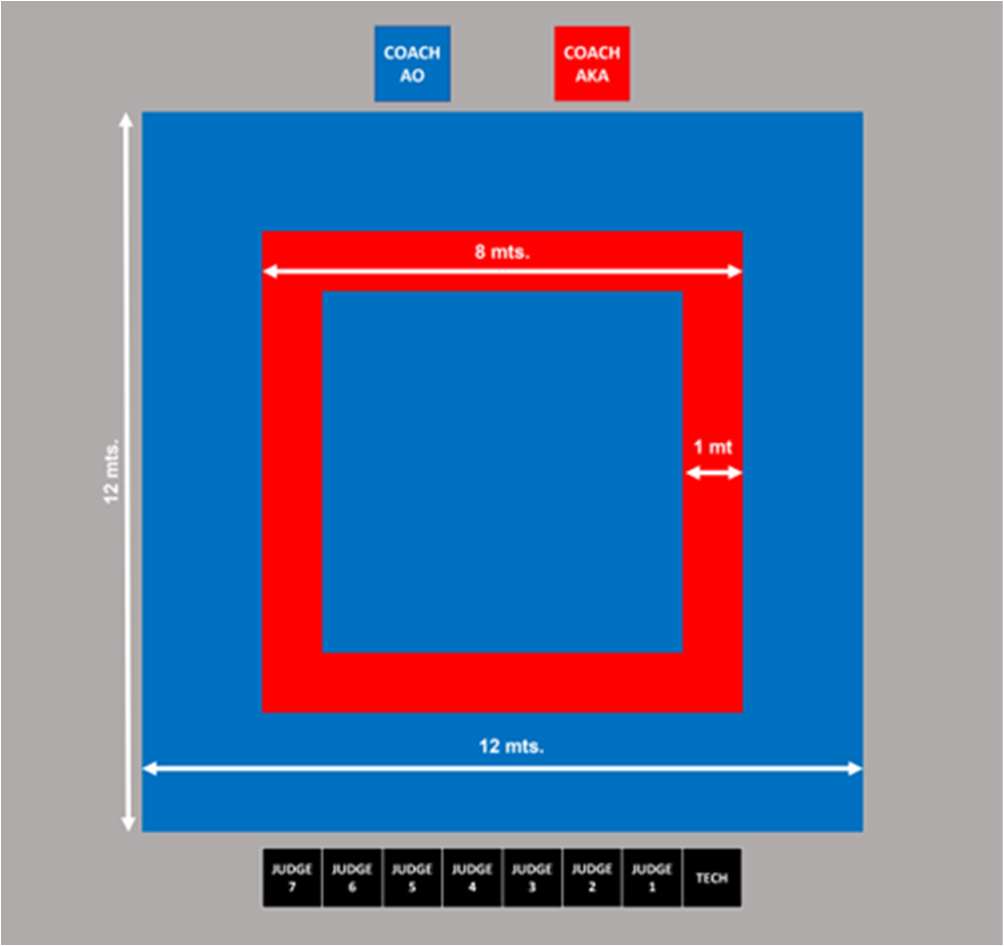
3.3 There must be no advertisement hoardings, walls, pillars etc. within one metre of the safety area's outer perimeter.
3.4 Coaches will be seated outside the safety area, on their respective sides of the Tatami towards the official table. In cases where the configuration of Tatami makes it impractical to place the Coaches facing the official table, they may instead be placed on each side of the official table.
In Para Karate competitions, Coaches and personal assistants will be seated outside the safety area on their respective sides. Where medal bouts or competitions take place on an elevated platform, personal assistants remain at ground level, outside the platform but behind or beside their Athlete; in such cases, the Coach's chair next to the platform remains empty during the Athlete's performance.
ARTICLE 4: OFFICIAL ATTIRE
4.1 Judges
4.1.1 The official uniform will be as follows:
- a) A single-breasted navy-blue blazer (colour code 19-4023 TPX)
- b) Plain light-grey trousers without turn-ups (colour code 18-0201 TPX)
- c) A white shirt with short sleeves
- d) Plain dark blue or black socks and black slip-on shoes for use on the match area
- e) An official tie, worn without a tie pin
- f) A black whistle with a discreet white cord for the whistle
4.1.2 The following additions to attire are allowed:
- a) A plain wedding band
- b) Voluntary religious headwear approved by the WKF
- c) A hairclip and discreet earrings
- d) Hair must be worn off the shoulders, and make-up must be discreet
- e) Heels of more than 4 cm may not be worn with the uniform.
It is strictly forbidden for judges to use phones, wear smart-watches or make use of private electronic devices within the confines of the field of play. Sunglasses are not allowed.
4.1.3 Judges must wear the official uniform at all tournaments, briefings, and courses.
4.1.4 For multisport events where a cross-sport uniform is provided for Judges at the cost of the LOC (local Organising Committee) with the feel & look of the specific event. The official uniform for Judges might be substituted by that common uniform, provided that it is requested in writing to the WKF by the event organiser and formally approved by the WKF.
4.1.5 If the Chief Referee agrees, officials may be allowed to remove their blazers.
4.1.6 The Referee Commission or Chief Referee may refuse the participation of any official who does not comply with this regulation.
4.2 Athletes
4.2.1 Athletes must wear a white, WKF approved Karategi without stripes, piping, or personal embroidery other than specifically allowed by the WKF EC and specified in the bulletin for the competition.
- a) For all official WKF events (World Championships) in which Para Karate events are held, the Karategi must have embroidered brands on the shoulders in red or blue, respectively, according to the draw.
Exceptions include the incumbent Senior World Para Karate Champion, who should wear a gold shoulder embroidery in the current Senior World Championships.
This applies to all individual Athletes. There is no WKF requirement for the Athletes from the same National Federation to wear the same brand of Karategi.
- b) Only the original manufacturer's labels can be displayed on the Karategi.
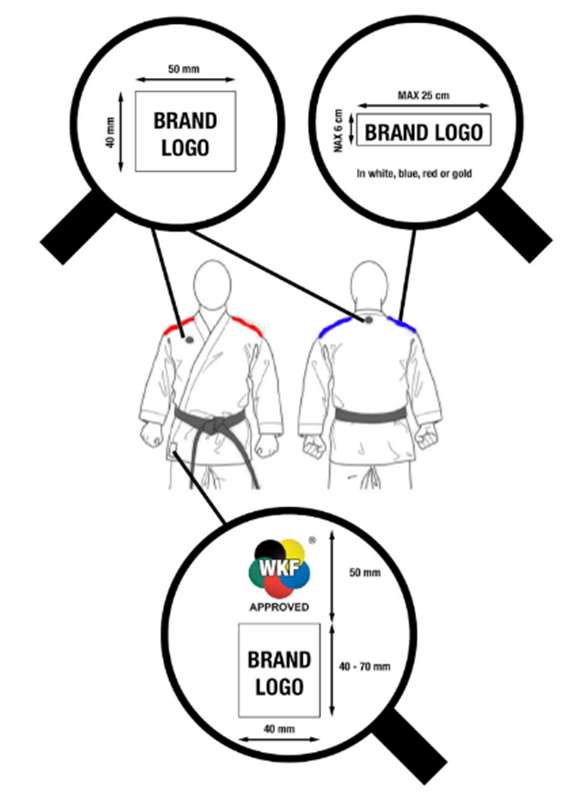
- a) The national emblem or flag of the country will be worn on the left breast of the jacket and may not exceed an overall size of 12cm by 8cm.
- b) In addition, identification issued by the Organising Committee will be worn on the back. The back number is mandatory for all official WKF events.
- c) Athletes must wear a WKF Approved red belt (AKA) or blue belt (AO) as allocated by the draw, without any personal embroideries or advertising or markings (BRAND LOGO) other than the customary label from the manufacturer. Belts of grade cannot be worn during the bout/performance.
- d) The red and blue belts must be around five centimetres wide and of a length sufficient to allow fifteen centimetres free on each side of the knot but not longer than three-quarters thigh length.
- e) The jacket, when tightened around the waist with the belt, must be of a minimum length that covers the hips, but must not be more than three-quarters thigh length.
- f) Female Athletes can wear a plain white T-shirt beneath the Karate jacket.
- g) Jackets without ties cannot be used. The jacket ties holding the jacket in place must be tied at the beginning of the performance.
- h) The maximum length of the jacket sleeves must be no longer than the bend of the wrist and no shorter than halfway down the forearm.
- i) Jacket sleeves may not be rolled up.
- j) The trousers must be long enough to cover at least two thirds of the shin and must not reach below the anklebone. Trouser legs may not be rolled up.
- k) The Karategi must not be altered or manipulated to change its shape.
In Para Karate, reasonable adaptations of the Karategi that are necessary due to the Athlete's Eligible Impairment (for example, adjustments related to amputation of a limb or non-standard body size/proportions) are permitted, provided that they do not give an unfair advantage, do not compromise safety, and are consistent with the Athlete's classification and/or medical documentation or specifically approved by the WKF Para Karate Commission / WKF EC
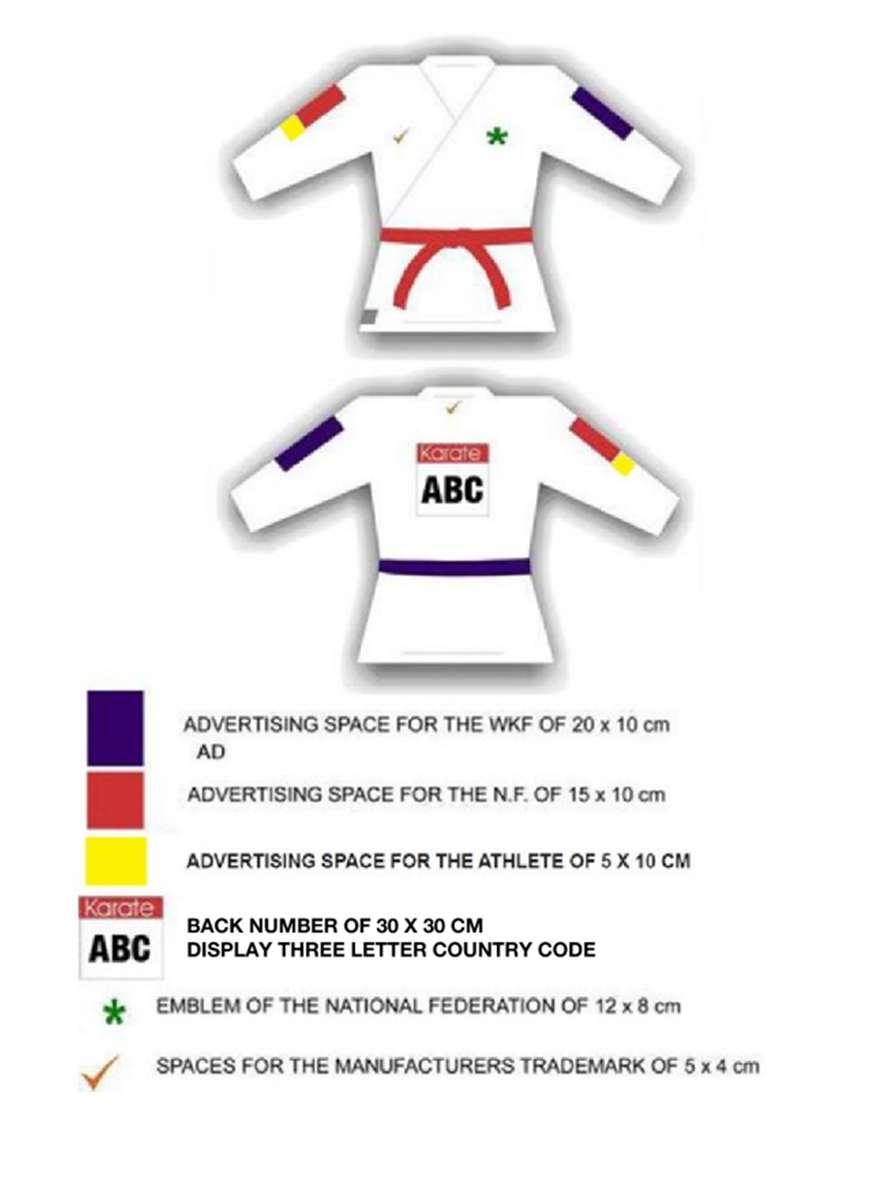
4.2.2 The WKF Executive Committee may authorise the display of special labels or trademarks (BRAND LOGOS) of approved sponsors.
4.2.3 Athletes may, according to their own individual choice, use religious headwear approved by the WKF: A black plain fabric head scarf covering the hair, but not the neck or throat area.
4.2.4 Glasses are generally not permitted. However, with the exception of visually impaired Athletes, prescription sport-glasses or soft contact lenses may be worn at the Athlete's own risk.
In Para Karate, visual aids that are medically required for Sport Classes K21 and K22 may be used, provided they are consistent with the Athlete's classification and medical documentation and approved by the WKF Para Karate Classification panel.
Athletes in Sport Class K10 (Visual Impairment) must remove all glasses when the blindfold is worn during kata performance.
4.2.5 Athletes must keep their hair clean and cut to a length that does not obstruct the performance. Hachimaki (headband) will not be allowed.
4.2.6 Hair slides are prohibited, as are metal hairgrips. Ribbons, beads and other decorations are prohibited. One or two discreet rubber bands on a single ponytail is permitted.
4.2.7 The wearing of any unauthorised apparel, clothing or equipment is forbidden.
In Para Karate, assistive devices and supports that are listed in the Athlete's classification and/or medical documentation and approved according to WKF regulations are not considered unauthorised equipment; however, their use must be confirmed by the Referee and approved by the Tournament Doctor and the Classifier.
4.2.8 In the case of Continental Federations, they will limit themselves to providers and brands already approved for WKF. The National Federation must also accept all WKF approved equipment for all local, regional or national competitions.
4.2.9 Athletes that appear at the competition area with unauthorized equipment or irregular Karategi will be given two minutes to correct the attire, and the Coach based on the report from the Chief Referee may have their coaching license suspended for a period of up to 6 months starting the date after the applicable tournament unless the equipment and attire has been checked beforehand by a WKF Controller.
4.3 Athletes' Equipment
The International Paralympic Committee (IPC) policies and International Standards on sports equipment, as set out in the IPC Handbook, apply to all IPC-recognised events and provide the general principles for safety, fairness, and non-discrimination.
WKF Para Karate equipment rules are established in a manner consistent with these principles. Approved equipment should offer similar conditions between Athletes in the same Sport Class (as well as provide safety, where applicable), to allow a fair comparison between the Athletes and their actual physical–technical abilities.
4.4 Accessory equipment – general principles
4.4.3 The accepted accessory equipment for Para Karate Kata competition includes, where appropriate to the Sport Class:
- blindfolds (Sport Class K10),
- sports glasses (Sport Classes K21, K22 and K30), and
- leg straps for wheelchair Athletes (Sport Class K30).
4.4.4 Equipment such as canes, crutches, walkers and other similar devices used for physical support are not permitted during kata performance, as they would alter the nature and presentation of the Kata.
4.4.5 Prostheses (except for eyes), canes, crutches, and other equipment used for physical support are not allowed in Competition and Classification.
4.4.6 For Classification purposes, the Classification Panel may request that Athletes be observed with or without their usual mobility aids or prostheses, in order to appropriately determine sport class and sport class status in accordance with the IPC Classification Code and the WKF Para Karate Classification Rules.
4.4.7 All equipment and accessory devices used by Athletes must be presented at equipment control and, where relevant, to the Classification Panel and Tournament Doctor. They may prohibit or require modification of any item that compromises safety, fairness, or the integrity of the sport.
4.5 Blindfolds (Sport Class K10)
4.5.3 Athletes of the Visually Impaired Sport Class (K10) are required to wear blindfolds that fully block vision and are suitable for blind sports. These may include IBSA-approved blackout glasses that meet WKF safety and performance requirements.
4.5.4 Blindfolds should be of a dark and discreet colour (e.g., grey, blue, black) and should not have any logos or markings of sponsors.
4.5.5 Blindfolds must remain firmly placed on the Athlete's face and head by means of an adjustable elastic or strap that must not become loose or undone during the performance of the Kata.
4.5.6 All blindfolds must be presented at equipment control and are subject to approval by the Para Karate Commission and/or Classification Panel during the Classification Session prior to competition.
4.6 Wheelchairs (Sport Class K30)
4.6.3 Use of a Wheelchair
4.6.4 Wheelchairs used in competition must be the same type and configuration as those used during the Classification Session. Changes must be approved by the Classification Panel prior to the start of competition.
4.6.4.1 If an undeclared change of wheelchair or configuration is identified that may affect sport class allocation or the Athlete's activity limitation profile, the Athlete may be subject to Classification review and/or sport class status review. Intentional non-disclosure or misrepresentation may lead to disqualification and disciplinary consequences in line with the IPC Classification Code and WKF disciplinary procedures.
4.6.5 Straps (Sport Class K30)
4.6.6 Straps used during competition must be the same type and configuration as those used in the Classification Session. Changes must be approved by the Classification Panel prior to the start of competition.
4.6.6.1 If an undeclared change of strap configuration is identified that may affect the Athlete's functional profile in competition, the Athlete may be subject to Classification review. Intentional non-disclosure or misrepresentation may result in disqualification and disciplinary action.
4.6.6.2 Leg straps to fix the legs of wheelchair Athletes (K30) are allowed. They must:
- be of white colour,
- be without logos, and
- be made from material that is not elastic or otherwise stretchable.
4.6.6.3 A maximum of three (3) straps may be used; these must be placed between the ankles and the hip. Fixation of the upper body is not allowed.
4.6.7 Types of Wheelchairs
4.6.7.1 All types of manual wheelchairs which allow the athletic and undisturbed presentation of a Kata, and which comply with the technical specifications below, are allowed.
4.6.7.2 The following are not permitted for competition:
- a) Walkers.
- b) Wheelchairs with electric drive support (e.g. electric motors integrated into wheel hubs).
- c) Electric wheelchairs.
4.6.7.3 Wheelchair Features
- a) The underside of the footrests must be designed to prevent damage to the tatami.
- b) One or two anti-tip castor(s) attached to the back of the wheelchair for safety purposes is permitted. They
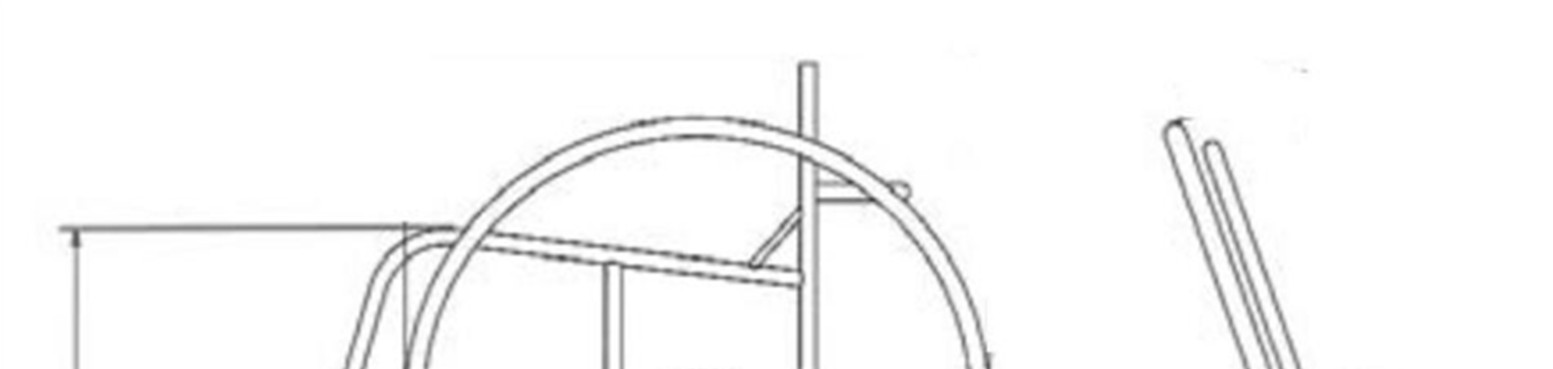
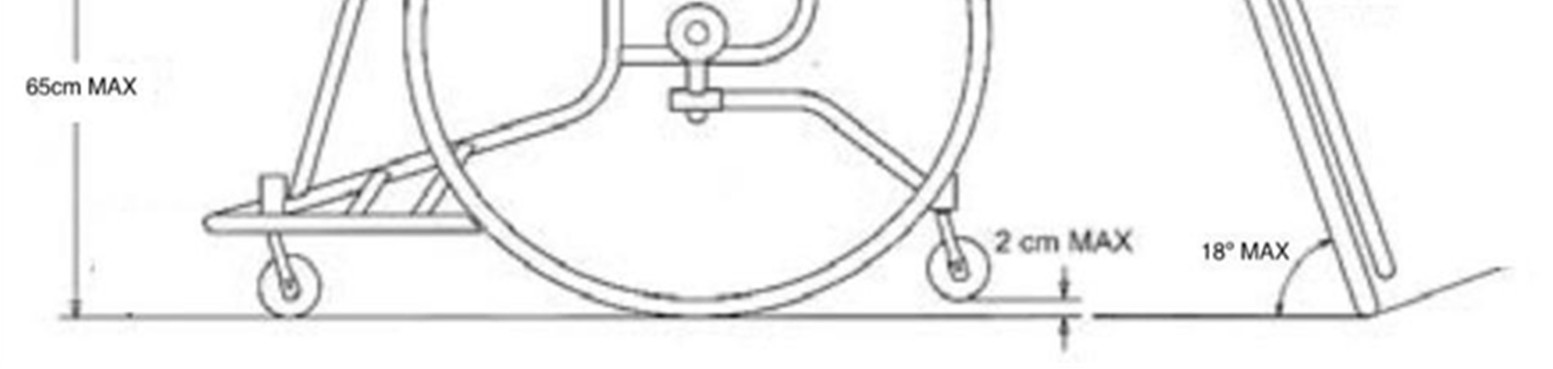
c) can be attached to either the frame or the rear axle and located at the rear of the wheelchair; castors that frequently or even continuously come into contact with the floor can be added to the wheelchair. The width between castors must be limited to the distance between the inside of the two big wheels. When the Athlete is sitting in the wheelchair in a forward driving position, the maximum permissible distance between the bottom of the anti-tip castor(s) and the tatami is 2 cm. The anti-tip castor(s) must not protrude beyond the vertical plane that touches the rearmost points of the driving wheels. This alignment should be judged with the wheelchair in its forward driving position.
- d) Large rear wheels may have a maximum camber of 18 degrees.
- e) The large wheels may be of any colour, as long as they do not stain or damage the tatami. Tyres or castors that mark the tatami are not permitted.
- f) The maximum height from the floor to the top of the cushion, when a cushion is used, or to the top of the seat platform (when a cushion is not used) must not exceed 65 cm.
- g) There must be one hand rim on each wheel.
- h) No steering devices or gears are allowed on the wheelchair.
4.6.8 Advertising on Wheels
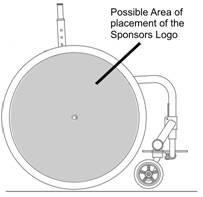
4.6.8.1 Multiple sponsor logos and advertising may be placed on the main wheels. The logo may take up to the size of the circle formed by the spokes. Both wheels may be used, provided that all advertising complies with WKF and IPC advertising and branding regulations.
4.6.9 Prohibited Advertising and Messages
4.6.9.1 Any identification, logo, or item that promotes or advertises political or religious views, or that provides illegal or false impressions of the sport, is prohibited.
4.6.9.2 Content that disparages the identity or reputation of the competition, the WKF, any Local Organising Commission, Major Games Organising Committee (such as the International Olympic Committee or the International Paralympic Committee), National Federation or competitor is strictly forbidden.
4.6.9.3 Advertising of products which harm the integrity of the sport or its Athletes (e.g. tobacco or alcohol) or that violate the WADA Anti-Doping Code or local laws is also prohibited.
4.6.10 WKF Discretion
4.6.10.1 WKF will have the general discretion to object to any form of advertising which hurts the integrity of the sport and its Athletes or lends a negative image to the competition. All such cases will be forwarded to the Disciplinary and Legal Commission.
4.6.11 Prohibited Logo Placement on Wheelchairs
Placement of sponsor logos or advertisements is prohibited in the following places of the wheelchair:
- a) the backrest,
- b) the side guards or armrests,
- c) the footplate,
- d) the castors,
- e) the frame.
4.7 Service Animals
4.7.3 Service animals are animals trained to aid people with disabilities and to perform specific functions, such as guide dogs for people with visual impairment or dogs trained to detect seizures or hypoglycaemia.
4.7.4 Medical service animals are allowed to accompany Athletes within the competition venue, subject to local laws and venue regulations. Only animals trained and certified to detect life-threatening conditions will be allowed at the external perimeter of the Competition Area, where they must remain without causing interference. Service animals may not enter the Competition Area.
4.7.5 Therapy animals, emotional-support animals, or pets that are not medical service animals are not permitted in the Competition Area or its perimeter.
4.8 Coaches and personal assistants
4.8.1 Each Athlete may be accompanied at the competition by a Coach, and, where required due to the Athlete's impairment, by one Personal Assistant in addition to the Coach. Both the Coach and the Personal Assistant must wear the official tracksuit of their National Federation and display their official accreditation at all times during the tournament, except for medal bouts of official WKF events, where:
- male Coaches and Personal Assistants are required to wear a dark suit, shirt and tie, and
- female Coaches and Personal Assistants may choose to wear a dress, pantsuit or a combination of jacket and skirt in dark colours.
Shoes must be closed; sandals or other open-toe shoes are not permitted.
4.8.2 The following additions to attire are allowed:
- a) A plain wedding band.
- b) Voluntary religious headwear approved by the WKF.
4.8.3 The Chief Referee may allow Coaches and Personal Assistants to use the Federation's official team T-shirt or a plain coloured T-shirt without writing or logos instead of the tracksuit jacket.
4.8.4 The Coach is responsible for sporting, tactical and technical support. The Personal Assistant is responsible only for support related to the Athlete's daily needs, safety and communication (for example, guiding to and from the competition area, wheelchair handling, assistance with clothing), and must not provide technical coaching during the performance.
4.8.5 In any unforeseen incident, such as additional Classification testing, Doping Control, fire or other need for emergency evacuation, the National Coaches are directly responsible for the safe removal of their Athletes. Coaches and Personal Assistants must ensure that the Athlete is appropriately accompanied throughout the competition and that any medication which may be required is accessible.
4.8.6 Where bouts or competitions take place on a platform, the Athlete may be guided to and from the platform by the Coach or Personal Assistant if necessary, in accordance with the access restrictions to the Competition Area defined in these Rules and the event bulletin.
ARTICLE 5: ORGANISATION OF KATA COMPETITION
5.1 General
5.1.1 Kata is not a dance or theatrical performance. It must adhere to the traditional values and principles. It must be realistic in fighting terms and display concentration, power, and potential impact in its techniques. It must demonstrate strength, power, and speed, as well as grace, rhythm, and balance.
5.1.2 Athletes must at all times follow the instructions given by the Chief Judge.
5.2 Competition format
5.2.1 Groups of 8 Athlete Elimination System is used for Para Karate competition.
5.2.2 The Individual Kata competition consists of individual performance in separate male and female divisions.
5.3 Seeding and order of performance
5.3.1 For World Individual Championships – Phase 2, and Continental Championships, the four top ranked Athletes in the WKF World Ranking present as per the day before the competition are seeded.
5.4 Reporting of kata to be performed
5.4.1 It is the sole responsibility of the Coach, or in the absence of a Coach, or the Competitor to ensure that the Kata as notified to the Runner is appropriate for that particular round.
5.4.2 Should there be any discrepancy between the number and the name of the kata registered for performance, the number, as per the official WKF Kata list, will prevail.
5.5 Failure to appear on time
5.5.1 Individual Athletes that do not present themselves when called, or decide not to continue, will be disqualified (KIKEN) from that category. Disqualification by KIKEN means that the Athletes are disqualified from that category.
5.6 Groups with 8 Athletes Elimination System
5.6.1 The number of Athletes will determine the number of groups to facilitate the elimination rounds. The following table summarises the number of pools and groups according to the number of Athletes:
| Number of Athletes | Number of groups | Number of Kata performed to win | Athletes in the second round |
|---|---|---|---|
| 2 | 1 | 1 | Zero (No second round) |
| 3 | 1 | 2 | Medal Bout (only for gold) |
| 4 | 2 | 2 | Medal Bout (only for gold) |
| 5 to 10 | 2 | 2 | Medal Bout |
| 11 to 24 | 2 | 3 | 8 Athletes |
| 25 to 48 | 4 | 4 | 16 Athletes |
| 49 to 96 | 8 | 4 | 32 Athletes |
5.6.2 Groups of eight (with the exceptions explained for less than 11 or more than 96) and for each round reduce the number of Athletes per group to 4 passing on to the next round – until only two groups of Athletes remains, whereupon the Athletes with the highest score in each of the two respective groups are pitted against each other competing for 1st place (the loser taking 2nd place) and the Athletes having the second highest score in each of the two groups are pitted against the third highest score in the other group to compete for the two 3rd places (bronze finals).
5.6.3 In the event that there are 2 Athletes a single kata is performed to determine 1st and 2nd place.
5.6.4 With 3 athletes one group is formed for the first round and the first two athletes meet to compete for 1st and 2nd place and the 3rd athlete is automatically placed 3rd.
5.6.5 With 4 athletes two groups of two are formed for the first round and the two winners meet to compete for 1st while the two losers are placed 3rd.
5.6.6 With 5-10 athletes two groups and the three highest scoring of each group go on to medal matches. The group will then follow the normal procedure that the highest scoring Competitor for each group will compete for 1st and 2nd place - and number 2 will meet number 3 from the other group and vice versa – unless there is only 5 Athletes total – in which case the number 2 competitor in the larger group will win his/her 3rd place on bye (walk-over).
5.6.7 If the number of athletes is 11-24, two groups are formed. After the first Kata the 4 top athletes form two groups of four after which the second Kata will determine the ranking for the 6 athletes (3 from each group) that will proceed to compete in the third round for the medals in the normal manner.
5.6.8 If the number of athletes is 25-48, four groups are formed. After the first Kata the top 4 athletes from each group will pass to the second round. In the second round, 16 Athletes are divided in 2 groups in 2 Tatami (8 Athletes for each group) and the second Kata will be performed. After the second round the 4 best athletes for each group (eight in total) will pass to the third round. In the third round, these 8 Athletes are divided into 2 groups (4 contestants for each group) and perform the third Kata. After the third round the 3 best athletes of each group will pass to the medal bouts, performing the fourth Kata.
5.6.9 The following table illustrates the competition format:
5.6.10
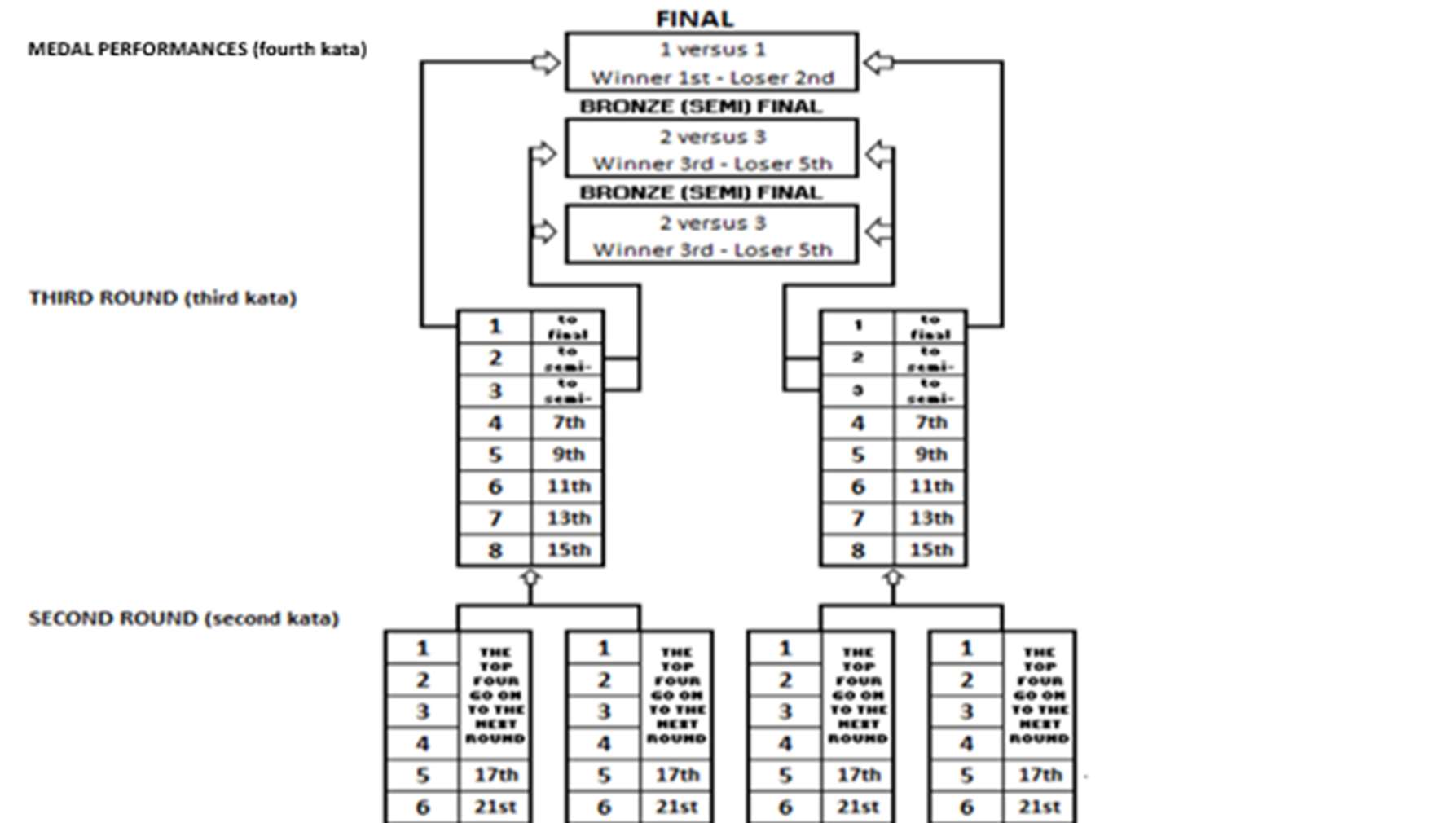
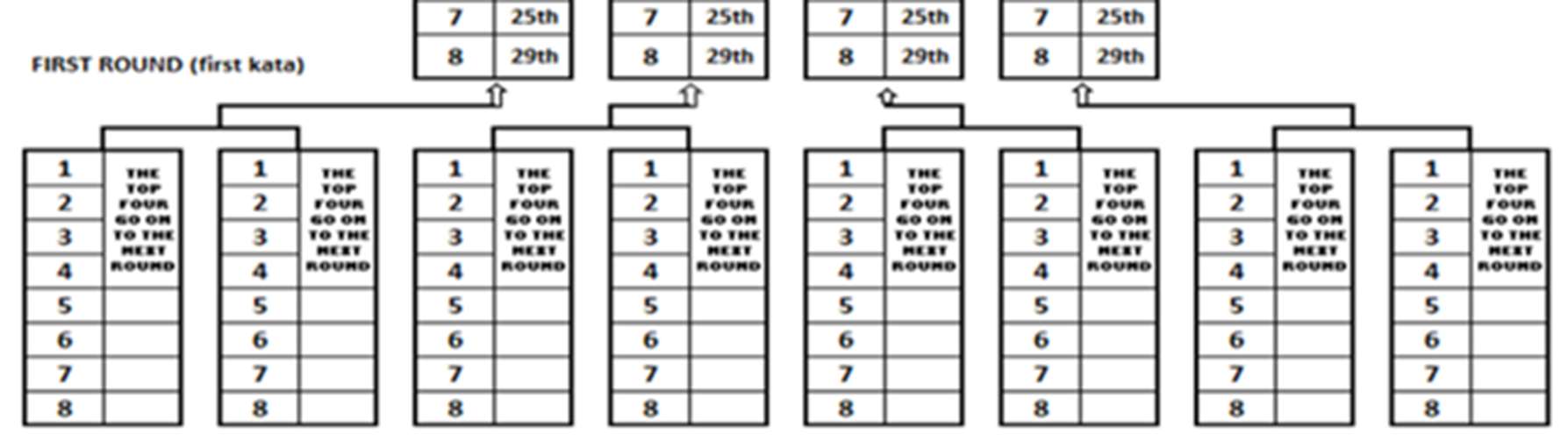
5.6.11 The Medal performances: The winners of the two pools compete for gold and silver. Number 2 in one of the last two groups pool will then meet number 3 in the other of the last two groups for to compete for the two bronze medals.
5.6.12 The losers of the bronze finals will place 5th.
5.7 Kata competition for those under 16 years of age
There are no specific deviations from the standard rules, but a limitation to the Kata list to less advanced Kata may be used.
5.8 Coaching
5.8.1 In World Championships, Kata coaches need to be part of a National Federation delegation and have the required Coach certification level, when acting during the bout of an Athlete.
ARTICLE 6: THE JUDGING PANEL
6.1 For all official WKF competitions, the panel of seven Judges for each round of competition will be designated by random selection, deploying a computer program.
6.2 For each mat, one Judge is designated as the Tatami Manager and will assume the lead in conducting any required communication with the Software technician and handle any unanticipated issue among the Judges.
6.3 Judges-deployment and panel allocation for the eliminatory rounds: The RC Secretary will facilitate to the Software technician handling the electronic drawing system a list containing the Judges available per Tatami. This list is done by the RC Secretary once the Athletes draw is finished and at the end of the Referees' briefing. This list must only contain Judges present at the briefing and must comply with the above-mentioned criteria. Then for the Judges' draw the Software Technician will enter the list in the system and seven Judges out of each Tatami deployment will be randomly selected as judging panel.
6.4 For medal bouts the Tatami Managers will provide the RC Chairman and the RC Secretary with a list containing available officials from their own Tatami after the last performance of the eliminatory round is finished. Once the list is approved by the RC Chairman, it will be given to the Software Technician for entry into the system. The system will then randomly allocate the Judging panel, which will only contain the seven Judges.
6.5 As found expedient, the Announcer and the Software Technician operating the electronic judging system may be the same person.
6.6 Furthermore, the organisers have to provide Runners for each competition area familiar with the WKF Kata list to collect and record the chosen Kata of the Athletes before each round and bring the listing to the Software technician. The Tatami Manager is responsible for overseeing the operation of the Runner(s).
6.7 The Judges of a Kata bout must not have the nationality or be from the same National Federation of either of the participants or have any other conflict of interest. It remains the duty of any official to self-report on any possible conflict of interest before the bout or match starts.
6.8 If manual judging by paper scorecards is employed, five Judges will be used: four placed at each corner of the Tatami and one functioning as Head Judge centered at the side closest to the official table.
ARTICLE 7: EVALUATION
7.1 Official Kata list
7.1.1 Only Kata from the WKF official Kata list may be performed. The official kata list is found in APPENDIX 1.
7.1.2 Names of some Kata are duplicated due to the variations customary in spelling in Romanisation. In several instances, a Kata may be known under a different name from style (Ryu-ha) to style, and in exceptional instances, an identical name may in fact be a different Kata from style to style.
7.2 Number of Kata required
7.2.1 A visually (K10) or physically (K30) impaired Athlete must perform a different kata, for each round unless the Kata is performed as a tiebreaker.
7.2.2 Athletes from the Intellectually Impaired category (Sport Classes K21 and K22) may perform the same Kata in each round; thus, repetition of the Kata is allowed.
7.3 Assessment
7.3.1 The performance is evaluated from the bow starting the Kata until the bow ending the Kata.
7.3.2 Slight variation as taught by the Athlete's style (Ryu-Ha) of Karate will be permitted.
7.3.3 Deviations may be acceptable due to the type of impairment.
7.3.4 Alterations may serve as alternatives for non-executable techniques (for example, hand techniques or raising the wheelchair, instead of kicks, for Wheelchair Athletes, Hikite to the wheelchair wheel instead of to the hip, etc.). Turns may be used instead of jumps for Athletes of all Classes.
7.3.5 Kata must have recognisable content and characteristics of the original kata.
7.4 Point system
7.4.1 Performances are given a score using a scale from 5.0 to 10.0 in increments of 0.1 - where 5.0 represents the lowest score possible for a Kata that is accepted as performed - and 10.0 represents a perfect performance. A disqualification is indicated by a 0.0 score.
7.4.2 The Compensation Score (Extra Points) issued by the Classification Panel will then be added to the Judges' Score, to adjust for how the Athlete's Impairment affects Kata performance (as described in the WKF Para Karate Classification Rules).
7.4.3 The system will eliminate the highest and lowest scores:
| JUDGE 1 | JUDGE 2 | JUDGE 3 | JUDGE 4 | JUDGE 5 | JUDGE 6 | JUDGE 7 | EXTRA SCORE | TOTAL |
|---|---|---|---|---|---|---|---|---|
| 7.6 | 7.6 | 8.2 | 7.7 | 7.5 | 7.8 | 8.1 | 1.2 | 40.0 |
7.5 Score levels
For the purpose of uniform application of the scale used in scoring the following guideline applies:
| Score | Level |
|---|---|
| 10 | Perfect |
| 9 - 9.9 | Excellent |
| 8 - 8.9 | Very good |
| 7 - 7.9 | Good |
| 6 - 6.9 | Acceptable |
| 5 - 5.9 | Insufficient |
| 0 | Disqualified |
7.6 Criteria for evaluation
Judges apply the standard WKF Kata criteria listed in the left column, interpreted in light of the sport-class–specific guidance on the right.
Kata Performance (standard criteria):
1. Stances
2. Techniques
3. Transitional movements
4. Timing and synchronisation
5. Correct breathing
6. Focus (KIME)
7. Conformance: Consistency in the performance of the KIHON
8. Strength
9. Speed
10. Balance
Technical performance specification according to the sport class:
K10 – Visually Impaired Athletes
- Recognisable embusen and orientation (start/finish area, main directions).
- Stable stances, posture and balance without visual reference.
- Precise, coordinated techniques in correct directions with clear endpoints.
K21–K22 – Intellectually Impaired Athletes
- Complete kata with simple, consistent rhythm and limited unnecessary pauses.
- Fluid transitions between techniques and stances.
- Clear basic techniques with arms, legs and body moving in coordination.
K30 – Physically Impaired Athletes (Wheelchair users)
- Controlled, purposeful wheelchair movement following the general kata line.
- Controlled posture and trunk alignment within the Athlete's functional abilities, with clear upper-body techniques and kime.
- Coordination between wheelchair motion and technique execution (e.g. stopping/turning in time with techniques).
7.7 Resolving ties
Ties are resolved by the following steps to determine the winner:
1. The one having the highest score when including also the lowest score obtained in the performance between the two Athletes (Results given by 6 of the 7 Judges).
2. The one having the highest score including both the lowest and highest score obtained in the performance between the two Athletes (Results given by all 7 Judges).
3. Highest World Ranking at the date of the competition.
4. Repeat Kata performance.
7.8 Fouls
The following fouls, if apparent, must be considered by the Judges.
They shall be evaluated in relation to the Athlete's Sport Class and functional abilities. Minor deviations that are clearly a direct consequence of the eligible impairment and consistent with the Sport Class should not be over-penalised.
1. Announcing the kata at the wrong time, e.g. announcing the kata before, instead of after, the bow.
2. Minor loss of balance or posture with quick recovery, relative to the Athlete's usual functional capacity.
3. Incorrect or incomplete execution of a movement, such as failure to fully execute a block or punching clearly off target.
4. Asynchronous movements, such as delivering a technique clearly before or after completion of the body transition.
5. Use of audible cues from any other person (including the Coach) to guide tempo or sequence, where the Athlete is otherwise able to continue independently.
6. Theatrical behaviours such as deliberate stamping of the feet, slapping the chest, arms, or Karategi, or inappropriate, exaggerated exhalation. These must be considered very serious fouls, on the same level as one would penalise a temporary loss of balance.
7. Incorrect Kiai. Kiai must be short, concentrated, and simultaneous with the technique.
8. Belt coming loose to the extent that it is clearly coming off the hips during the performance.
9. Other equipment (e.g. leg straps, sports glasses) moving out of place during the performance without immediate correction, provided safety is not compromised.
10. Unjustified time-wasting, including prolonged marching, excessive bowing, or prolonged pause before starting the performance. Reasonable additional time for orientation, wheelchair positioning, or communication related to the impairment should not be penalised.
11. A distinct pause or stop in the performance from which the Athlete subsequently resumes and completes the kata.
12. Any minor loss of balance, or loss of seated balance in K30, other than a fall, where the Athlete is able to safely continue and complete the kata.
7.9 Disqualification
A Competitor may be disqualified for any of the following reasons:
1. Not announcing the kata, announcing the wrong kata, or performing a kata other than the one pre-announced to the official table.
2. Failing to bow at the beginning and/or completion of the kata performance.
3. Not starting the kata facing the Judges.
4. Total loss of balance or fall that prevents the Athlete from safely continuing or completing the performance, including in K30 an uncontrolled loss of seated balance that makes continuation unsafe.
5. Omitting or adding movements, or otherwise substantially changing the performance from its original form.
6. Belt falling off completely during the performance.
7. For K10 (Visually Impaired Athletes): blindfolds moving out of the correct position so that they partially or fully uncover one or both eyes during the performance.
8. Failure to follow the instructions of the Chief Judge or other misconduct (SHIKKAKU).
9. For K30 (wheelchair kata): using lower limb function in a way that is clearly incompatible with the Athlete's allocated Sport Class, such as standing up or weight-bearing on the legs during the performance, or using the non-affected leg during the wheelchair kata performance, as confirmed by the Chief Judge and, where necessary, the Classification Panel.
10. Coach instructions or deliberate external guidance during the kata performance, such as spoken directions or visible signals after the start of the performance, beyond what is permitted for Athlete safety and basic orientation, or continuing after a warning.
11. Use in competition of equipment or configuration that differs significantly from that presented and approved at Classification and/or equipment control, and that provides an unfair advantage or changes the Athlete's functional profile, as confirmed by the Technical Delegate and/or Classification Panel.
12. Intentional misrepresentation of impairment or non-cooperation with Classification, as determined under the WKF Para Karate Classification Rules and the IPC Classification Code. Such cases may lead to SHIKKAKU and additional disciplinary and classification sanctions.
In Para Karate, potential reasons for disqualification must be treated with particular care, as certain eligible impairments or underlying health conditions may influence movement patterns or behaviour during performance. The Chief Judge must call Shugo before any decision of disqualification is taken, in order to allow consultation among the Judges and, where appropriate, with a representative of the Para Karate Commission or the Classification Panel. Following this consultation, the situation may be confirmed as grounds for disqualification, treated as a foul, or left without consequence, according to the principles of fair and safe competition.
7.10 Excessive celebration and political or religious demonstrations
Athletes are expected to respect the ceremony of salutations before and after the performance. Any excessive celebration, such as falling on one's knees etc., or political or religious expressions, during or immediately after the performance is, prohibited and will be subject to a fine equal to the amount determined by the EC for the protest fee. The Tatami Manager or Chief Referee will notify the official table.
7.11 Manual Judging by use of paper scorecards
7.11.1 Manual judging by use of manual scorecards may be used for competitions where electronic scoring equipment is not available or where a technical malfunction makes it impossible to use the electronic system.
7.11.2 After the Competitor has completed the kata performance, the Head Judge will blow the whistle, and all five Judges (including the Head Judge) will simultaneously display their paper scorecards to indicate the score awarded. The Judges will hold the scorecards visible to the official table until the Head Judge blows the whistle a second time, signalling that the scorecards are to be taken down.
7.11.3 The scores will then be registered manually in accordance with the applicable scoring procedure (including elimination of highest and lowest scores, where relevant). The Officials at the scoring table will add any applicable Compensation Score (Extra Points) for the Sport Class and calculate the final score, which will then be announced in the usual manner.
ARTICLE 8: OPERATION OF MATCHES
8.1 General operation
8.1.1 Para Karate kata events are conducted according to the WKF competition format (elimination groups and medal bouts), with the adaptations described in these Rules.
8.2 Registration of kata
8.2.1 Before each round, the Athlete or Coach must submit the chosen kata to the assigned Runner, who will relay the information to the Software Technician of the electronic judging system or to the designated scoring Officials in case of manual judging.
8.2.2 It is the sole responsibility of the Coach, or in the absence of a Coach, the Athlete, to ensure that the kata notified to the Runner is appropriate and permitted for that particular round.
8.2.3 Should there be any discrepancy between the number and the name of the kata registered for performance, the number, as per the official WKF Kata list, will prevail.
8.3 Non-appearance and withdrawal
8.3.1 Individual Athletes who do not present themselves when called, or who decide not to continue, will be disqualified (KIKEN) from that category. Disqualification by KIKEN means that the Athlete is withdrawn from that category only.
8.4 Access to the competition area and starting procedure
8.4.1 The Athlete may be guided to the competition area boundary by one Accompanying Person (Coach or Personal Assistant). The Athlete will then move to the starting position independently, within the perimeter of the Competition Area. The Accompanying Person is not allowed to enter the Competition Area.
8.4.2 When the Athlete is called (i.e. as soon as the Athlete's name appears on the screen or is announced), the Athlete must promptly proceed to the starting point for the kata, facing the Judges, without unnecessary or prolonged marching.
8.4.3 The starting point for the performance is anywhere within the perimeter of the competition area, unless otherwise specified in the event bulletin.
8.4.4 After taking the starting position and bowing, the Athlete must clearly – if possible given the nature of the impairment – announce the name of the kata that is to be performed and then start the performance without further delay.
8.5 Elimination performances (group rounds)
8.5.1 At the start of each round, the Athletes of the group line up at the match area perimeter facing the Judges. A "round" is understood as one performance of all Athletes in a group.
8.5.2 Following the bows – initially "SHOMEN NI REI" and subsequently "OTAGAI NI REI" – the Athletes step back out of the match area and wait to be called in the order established by the draw.
8.5.3 When called, each Athlete steps up to the starting point for the kata, facing the Judges, performs the bow, announces the kata, and begins the performance.
8.5.4 At the end of the performance, which is defined as the final bow in the kata, the Athlete must remain on the tatami in the designated position and wait for the announcement of the evaluation. After the score has been announced, the Athlete bows and leaves the tatami.
8.5.5 At the end of each group, all Athletes in that group line up again at the match area perimeter. The announcer (speaker) then announces the Athletes who advance to the next round, and the names of the top Athletes are shown on the monitor. The Athletes bow and leave the competition area.
8.6 Medal bouts
8.6.1 The medal bout begins with the Athletes entering the competition area and bowing to the Judges ("SHOMEN NI REI"), then bowing to each other ("OTAGAI NI REI"). The Athlete with the red belt (AKA) performs the kata first, followed by the Athlete with the blue belt (AO) upon completion of AKA's kata.
8.6.2 While the opponent is performing, the Athlete not performing stands at the designated position near the perimeter of the competition area and refrains from moving or talking so as not to disturb the other Athlete's performance.
8.6.3 At the end of the performance, which is defined as the final bow in the kata, the Athlete returns to the designated position at the end of the competition area and waits for the announcement of the result.
8.6.4 When an Athlete has completed the kata, the Judges (including the Chief Judge) give their score by electronic device, or – where applicable – by manual judging procedures described in Article 5.12.
8.6.5 Once the announcement of the winner is given, the Athletes, upon the signal "OTAGAI NI REI," bow to each other, and upon "SHOMEN NI REI," bow to the Judges and leave the tatami.
ARTICLE 9: OFFICIAL PROTEST
9.1 General provisions
9.1.1 No one may protest about a Judgement to the members of the Refereeing Panel.
9.1.2 If a Refereeing procedure appears to contravene the rules, the Athlete's Coach or their official representative are the only ones allowed to make a protest.
9.1.3 The protest will take the form of a written report submitted immediately after the bout in which the protest was generated. The sole exception is when the protest concerns an administrative malfunction.
9.1.4 Any protest concerning application of the rules must not necessarily impede the progression of the competition and the intent to protest should be announced by the Coach or NF representative immediately after the end of the bout.
9.1.5 The Coach / NF representative will request the official protest form [APPENDIX 3] from the Tatami Manager and will be expected to have it completed, signed, and delivered to the Tatami Manager with the corresponding fee within 5 minutes after announcing the intent to protest.
9.1.6 Failure of a Coach / NF representative to deliver a protest in a timely manner can lead to its rejection if such delay, in the opinion of the Appeals Jury, is without reasonable justification and impedes the progression of the competition.
9.1.7 The Tatami Manager will immediately add the names of the officials and hand the completed protest form to a representative of the Appeals Jury. The Appeals Jury will, without delay, review the circumstances leading to the protested decision. Having considered all the facts available, they will produce a report and shall be empowered to take such action as may be called for. The protest will be reviewed by the Appeals Jury, and as part of this review, the Jury will study the evidence available in support of the protest.
9.1.8 The protest may also be directly decided and announced to the Appeals Jury by the RC Chairman or the Chief Referee of the event, in which case no payment of a protest fee will be applicable.
9.1.9 In case of an administrative malfunction during a bout in progress, the Coach can notify the Tatami Manager directly. In turn, the Tatami Manager will notify the Chief Judge.
9.1.10 The protest must give the name and country of the Athletes, the Judges officiating, and the precise details of what is being protested. No general claims about overall standards will be accepted as a legitimate protest. The burden of proving the validity of the protest lies with the complainant. The protest must be submitted to a representative of the Appeals Jury by the Tatami Manager. In due course the Jury will review the circumstances leading to the protested decision.
9.1.11 The protester must deposit a Protest Fee as agreed by the WKF EC, and this, together with the protest must be lodged with the Tatami Manager who will turn it over to a representative of the Appeals Jury.
9.1.12 Any protest should be announced by the Coach or NF representative immediately after the end of the bout.
9.1.13 The decision of the Appeals Jury is final and may only be overruled by a decision of the Executive Committee upon request of the WKF President.
9.1.14 The Appeals Jury may not impose sanctions or penalties. Their function is to pass judgment on the merit of the protest to start required actions from the RC and OC to take remedial action to rectify any Refereeing procedure found to contravene the rules.
9.1.15 If the protest involves Athletes in an ongoing category, then the next round that could involve the athlete must be postponed until the appeal is decided.
9.2 Composition of the Appeals Jury
9.2.1 The Appeals Jury is comprised of three Senior Referee representatives appointed by the Referee Commission (RC) or the Chief Referee. No two members may be appointed from the same National Federation. They will be numbered from 1 to 3.
9.2.2 The RC will also appoint three additional members with designated numbering from 4 to 6 that automatically will replace any of the originally appointed Appeals Jury members in a conflict-of-interest situation. I.e., where the jury member is of the same nationality or have a family relationship by blood or as an In-Law with any of the parties involved in the protested incident, including all members of the Refereeing panel involved in the protested incident.
9.3 Appeals Evaluation Process
9.3.1 It is the responsibility of the Tatami Manager receiving the protest to gather the Appeals Jury and deposit the protest sum with WKF for any declined protest.
9.3.2 The Appeals Jury will immediately make such inquiries and investigations, as they consider necessary to validate the merit of the protest.
9.3.3 Each of the three members is obliged to give their verdict as to the validity of the protest. Abstentions are not acceptable.
9.4 Declined and accepted protests
9.4.1 If a protest is found invalid, the Appeals Jury will appoint one of its members to verbally notify the protester that the protest has been declined, mark the original document with the word "DECLINED", have it signed by each of the members of the Appeals Jury, and inform the protester of the decision.
9.4.2 If the protest is accepted, the Appeals Jury will appoint one of its members who will verbally notify the protester that the protest has been accepted, mark the original document with the word "ACCEPTED", and have it signed by each of the members of the Appeals Jury, before depositing the protest with the Chief Referee, and returning the protest fee to the protester.
9.4.3 After a protest is accepted, the appeals Jury will liaise with the Organising Commission (OC) and Chief Referee to take such measures as can be practically carried out to remedy the situation including the possibilities of:
- Reversing previous judgments that contravene the rules
- Voiding results of the affected rounds from the point before the incident
- Redoing such bouts that have been affected by the incident
- Issuing a recommendation to the RC for any involved Judges evaluated for sanction.
9.4.4 The responsibility rests with the Appeals Jury to exercise restraint and sound judgment in taking actions that will disturb the program of the event in any significant manner. Reversing the results is a last option to secure a fair outcome.
9.5 Incident Report
9.5.1 After handling the incident in the above prescribed manner, the Appeals Jury will meet again and elaborate a simple protest incident report, describing their findings and state their reason(s) for accepting or rejecting the protest.
9.5.2 The report should be signed by all three members of the Appeals Jury and submitted to the Chief Referee and the Organising Commission.
ARTICLE 10: ADAPTATION OF THESE RULES TO EVENTS OUTSIDE THE WKF OFFICIAL EVENT PROGRAMME
10.1 National Federations may modify these rules for the purpose of national competitions or other competitions not on the official WKF programme, as long as these adaptations do not provide an advantage or disadvantage for particular styles of karate.
10.2 National Federations are encouraged to consult their national sports authorities for guidance on national law and/or guidelines for competitive sports for athletes under 16 years of age.
10.3 Any deviation from the Competition Rules applied to a competition must be announced in the official bulletin or invitation to the event.
ARTICLE 11: ISSUES NOT SPECIFICALLY COVERED BY THE RULES
From time to time, situations may occur where the rules fall short of giving specific instructions to resolve an issue. In such instances, the Chief Referee for the competition has the authority to resolve the issue by applying analogous resolutions to similar cases found in the rules or their best judgment. Before making a decision, the Chief Referee may consult the assigned WKF Representative for the tournament or escalate the issue to the Sports Commissioner for consultation before taking a decision.
APPENDIX 1: OFFICIAL KATA LIST
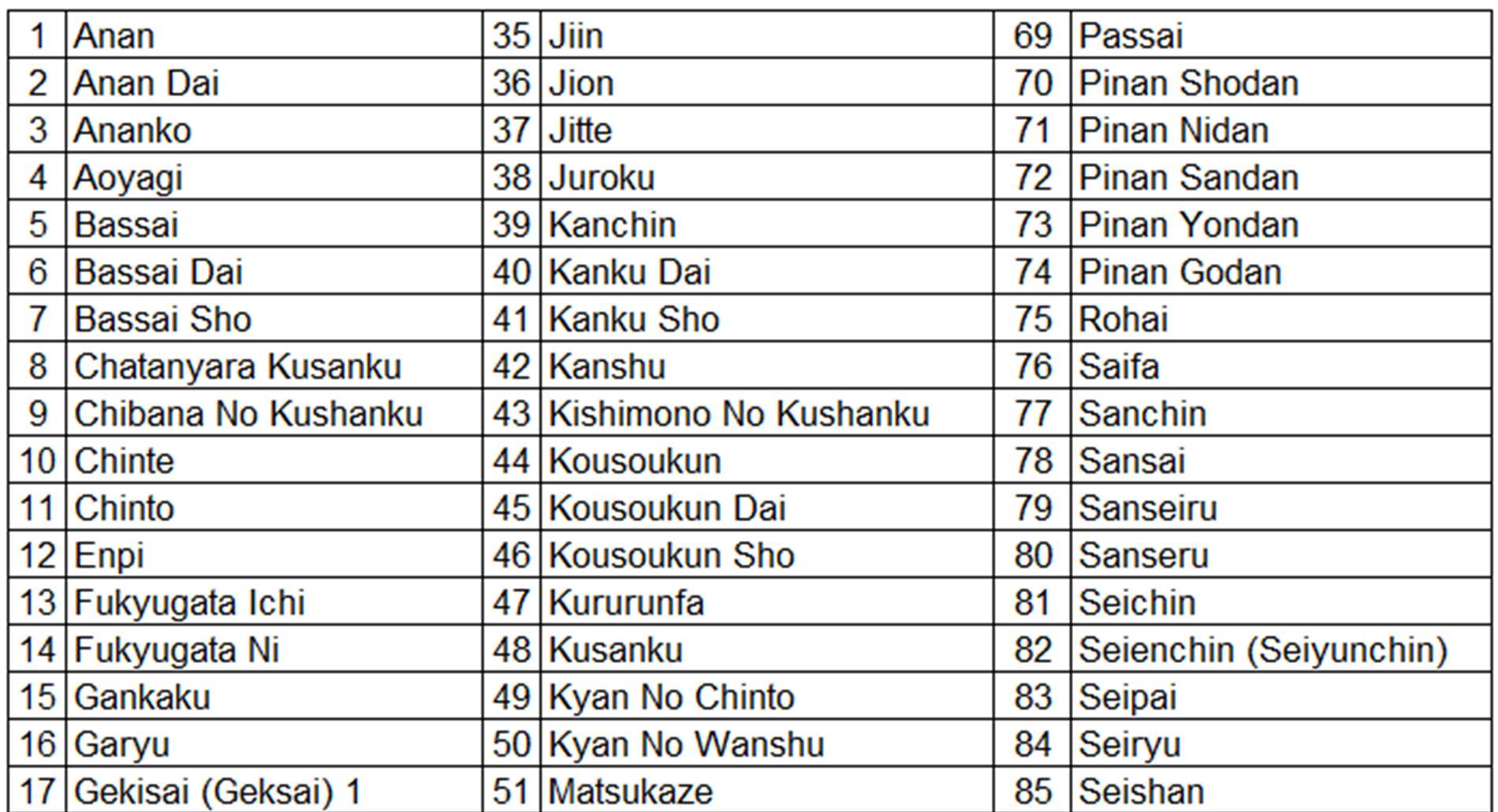
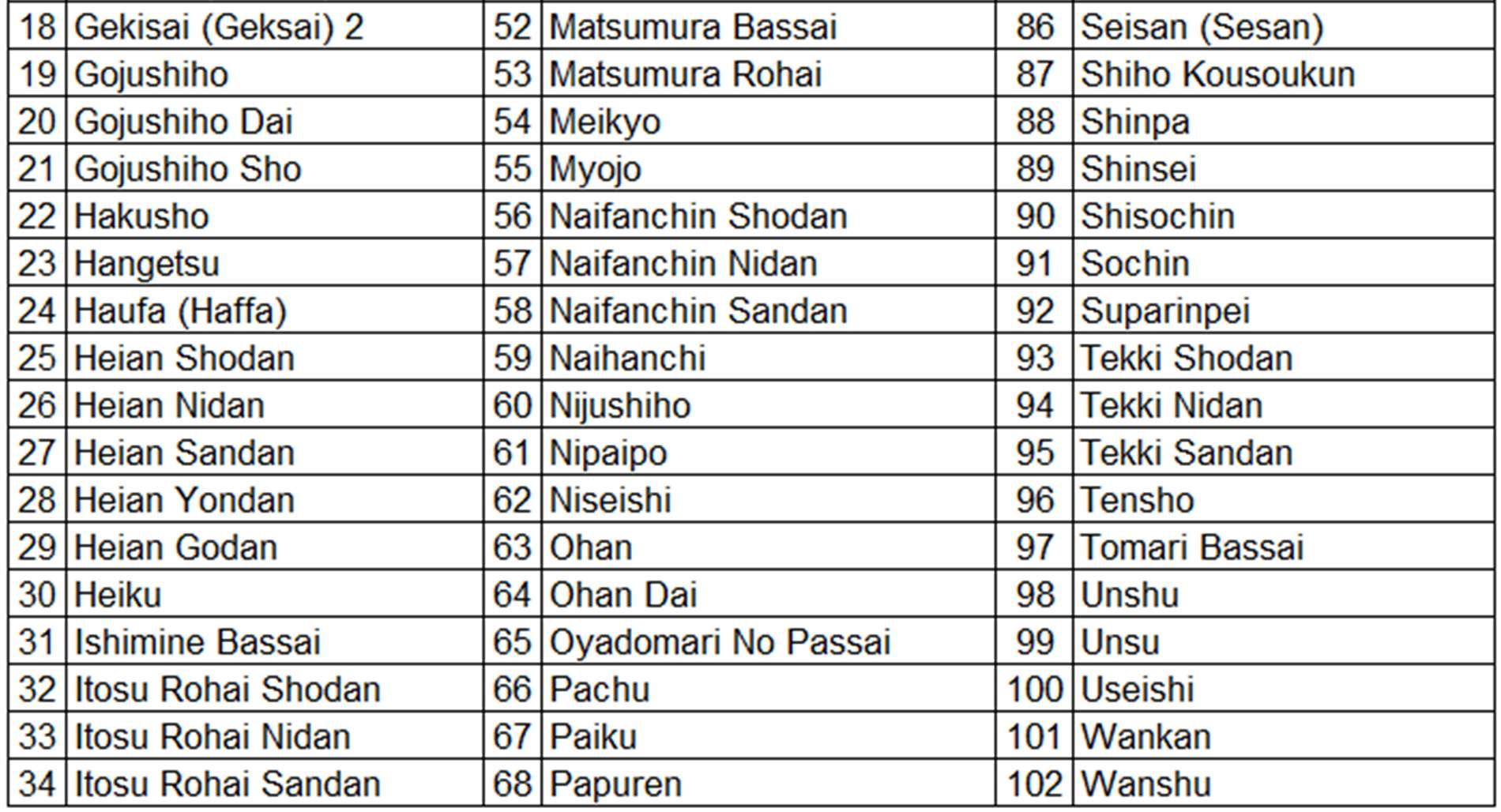
In reporting the kata to be performed use the designated number. Should there be inconsistency between the number and the name of the kata, the number will be considered the reported kata to be performed.
APPENDIX 2: KATA COMPETITION CATEGORIES
- BLIND/VISUALLY IMPAIRED FEMALE K10 (16+ years)
- BLIND/VISUALLY IMPAIRED MALE K10 (16+ years)
- INTELLECTUALLY IMPAIRED FEMALE K21 (16+ years)
- INTELLECTUALLY IMPAIRED FEMALE K22 (16+ years)
- INTELLECTUALLY IMPAIRED MALE K21 (16+ years)
- INTELLECTUALLY IMPAIRED MALE K22 (16+ years)
- WHEELCHAIR USER FEMALE K30 (16+ years)
- WHEELCHAIR USER MALE K30 (16+ years)
APPENDIX 3: KATA PROTEST FORM
WKF OFFICIAL PROTEST FORM

KATA
The protest must be prepaid.
Form fields (as laid out on the original form):
- DATE / COMPETITION / PLACE: …….. / …….. / ……..
- NAME OF THE ATHLETE / COUNTRY
- PROTEST DESCRIPTION (свободное поле для текста)
- NAME (подающего протест) / Valid as receipt by the WKF
- SIGNATURE
FOR OFFICIAL USE ONLY
- TATAMI N° / TM Manager:
- PANEL: Judge 1, Judge 2, Judge 3, Judge 4, Judge 5, Judge 6, Judge 7
- NAME
- COUNTRY